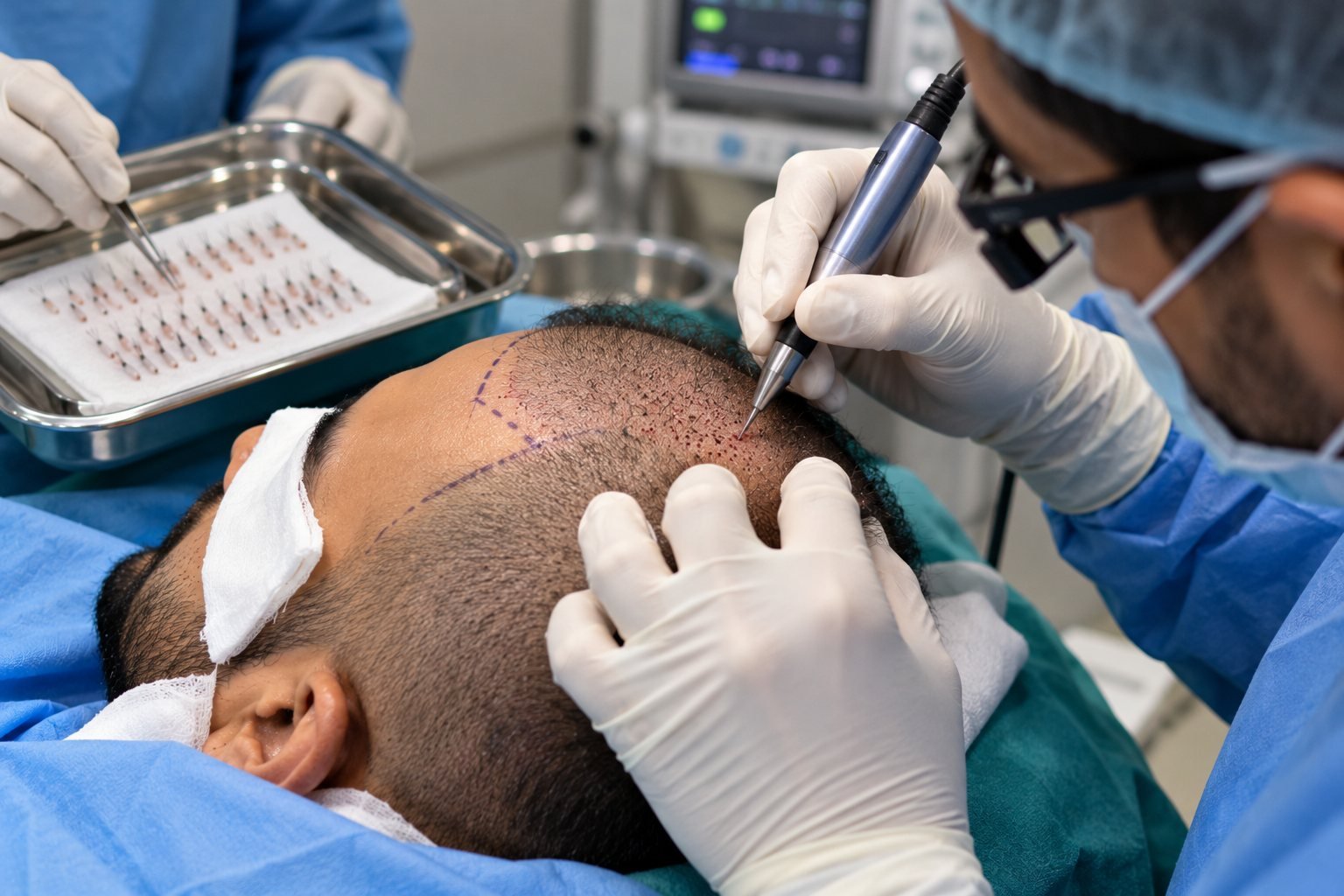
Follicular Unit Extraction. Individual grafts are harvested with a micro-punch, leaving tiny dot scars that are invisible even with short hair.
A hair transplant moves follicles from the donor area at the back and sides of the scalp — which is genetically resistant to balding — into areas where hair has thinned or receded.
Permanent result
Local anaesthesia
No linear scar (FUE)
Natural hairline design
Performed by
[Doctor's name], [Qualification]
Hairline designed for your face
02 — Conditions treated
Who we help with a transplant.
Transplants work best where hair loss has stabilised and there is a healthy donor supply.
01
Male pattern baldness
Receding temples, thinning crown and frontal loss (androgenetic alopecia).
02
Female hair thinning
Patterned thinning or a widening part where the donor area is stable.
03
Beard & moustache gaps
Patchy or sparse facial hair filled in with natural direction.
04
Eyebrow restoration
Thin, over-plucked or scarred brows rebuilt hair by hair.
03 — Suitability
Am I a good candidate?
Suitability is always confirmed by the doctor at consultation. As a general guide:
Usually a good fit if you
Have hair loss that has been stable for at least 12 months
Have dense, healthy hair at the back and sides of the scalp
Are over 23 and in good general health
Want a permanent rather than ongoing solution
Have realistic expectations about density
May not be suitable if you
Are losing hair rapidly or in an unpredictable pattern
Have a weak or very limited donor area
Have uncontrolled diabetes, bleeding or clotting disorders